Professor of Mathematics · University of Münster

Thomas
Nikolaus

My research develops higher-categorical and homotopy-theoretic methods for algebraic K-theory and related invariants. A central theme is the use of trace and prismatic methods, higher algebra, and stable ∞-categories to connect topology with arithmetic and geometry.

Sectional speaker, ICM 2022

Homotopy theory & higher categoriesHigher algebra & ring spectraAlgebraic K-theory, trace & prismatic methodsHermitian K- and L-theory, surgery & assembly maps
Thomas Nikolaus in front of a blackboard

Selected contributions

In my work, I develop abstract tools and theories that make previously inaccessible computations possible. The two long-term research programmes below are still active areas of my work.

Trace methods and the K-theory of ℤ/n

Together with Peter Scholze, I developed a homotopy-invariant framework for cyclotomic spectra and topological cyclic homology. With Benjamin Antieau, I further developed this theory through topological Cartier modules, giving an algebraic description of p-typical cyclotomic spectra. Joint work with Achim Krause on Bökstedt periodicity produced explicit calculations of the topological Hochschild homology of quotients of discrete valuation rings. Building on these computations and the preceding conceptual developments, joint work with Antieau and Krause gave an algorithm for all higher K-groups of ℤ/n, resolving a benchmark problem dating back to the early 1970s.

Grothendieck–Witt and L-theory

Together with collaborators, I am pursuing a long-term programme in hermitian K-theory and L-theory. Building on earlier work relating the L-theory of C*-algebras to topological K-theory and determining the L-spectra of ℤ, this programme led to a modern framework for hermitian K-theory of stable ∞-categories. The framework connects algebraic forms and stable homotopy theory with surgery and arithmetic groups, works integrally—including at the prime 2—and proves conjectures of Karoubi. A major application is the computation of the Grothendieck–Witt groups of ℤ—a longstanding open problem previously accessible only after inverting 2.

Academic leadership

In Münster, as spokesperson for the Cluster and CMM, and more generally in the mathematical community, I try to help create an environment that connects mathematical fields, supports early-career researchers, and makes ambitious collaborative research possible.

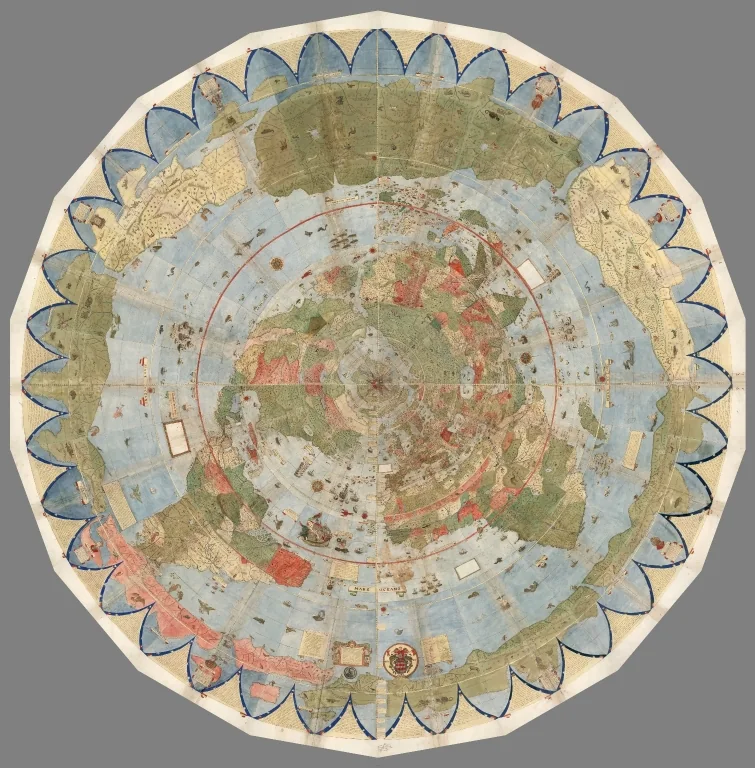
Urbano Monte, 1587

Collaborative research project

Homotopical Cartography Project

A collaborative research project at Mathematics Münster using homotopical methods to develop new mathematical insights. Our findings are collected in Exploration Charts, presenting results, examples, counterexamples, and proofs.

Explore the Atlas →

Online seminar

AI and the Future of Mathematics

A forum for discussing how artificial intelligence is changing mathematical research, discovery, and the future of the discipline.

View the seminar

Weekly research seminar

Oberseminar Topologie

Our weekly research seminar in the Topology Group, featuring international invited speakers on current developments in topology, higher algebra, and related fields.

View the seminar

2026–2027

Where to find me

Organising

Gauß Lecture 2027

Speaker: Catharina Stroppel

Categories and Symmetries

A conference in honour of Christoph Schweigert’s 60th birthday
Organised with Konrad Waldorf, Ingo Runkel, and Lukas Woike

Opening of the Centre for Mathematics Münster

Motives and Trace Methods

Organised with Paul Arne Østvær

Invited Talks

Assembly maps and geometric topology

Mathematics in society

Research · Education · Discussion AIMATH Initiative An open initiative presenting draft positions, questions, and perspectives on the future of mathematical research and education in the age of AI. Initiated by Claudia Alfes, Thomas Nikolaus, and Andreas Thom. Visit ai.math.ms → 9 October 2026 · 19:00 · Online AI-generated proofs: What is the future of mathematics? A public panel discussion with Peter Scholze and Christoph Spiegel, hosted jointly by the mathematics clusters in Berlin, Bonn, and Münster. View event →
6 November 2026 · Grades 3–7 Kinder-Uni: “Mathe-Geheimnisse entdecken” A children’s university lecture about discovering secrets of shapes and numbers.
Science policy · FAZ, 2025 We Need National and European Data Institutes A co-authored contribution on the institutional foundations Europe needs for AI and data-driven research.